

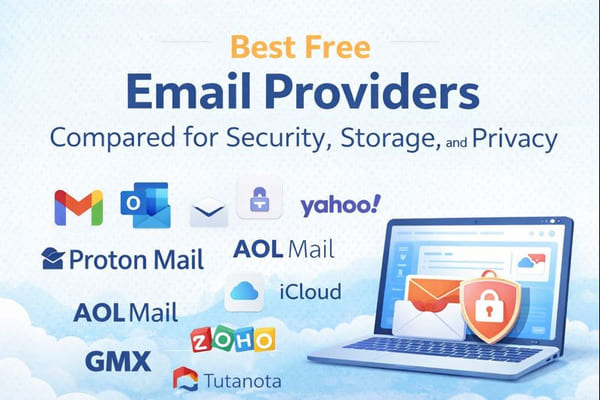
Looking for the best free email providers that offer reliable service at no cost? You’re in the right place! We’ve compiled a list of top free email services like Gmail, Proton Mail, Zoho Mail, Outlook.com, Yahoo Mail, iCloud Mail, and AOL Mail. We compare their free storage, features, and ease of setting up a free email account to help you find the perfect email provider for your needs. If you’re specifically looking to create a Hotmail account (now managed through Outlook.com), here’s our step-by-step guide for 2026 to help you set it up correctly.
In today’s digital world, your email is your gateway to everything—from personal chats to work opportunities. Why settle for less than the best free email? Whether you’re leaving Gmail for better privacy, need large inbox storage like AOL Mail, or want a secure email with end-to-end encryption from Proton Mail, we’ve got you covered. These email providers offer free plans with essentials like two-factor authentication, generous attachment sizes, and, in some cases, no phone number required for signup. If avoiding phone verification is important to you, here’s a detailed guide on email services that don’t require a phone number to register.
And if you want to keep your inbox clean and free from spam, you can use our Cleanfox platform for free.
Analysis of Security Features
End-to-End Encryption
When it comes to protecting your emails from prying eyes, end-to-end encryption (E2EE) ensures that only you and the recipient can access the messages. Proton Mail stands out with its open-source, asymmetric E2EE enabled by default—even on the free version. Tutanota takes it a step further by incorporating quantum-resistant algorithms like Kyber-1024 alongside AES-256, offering future-proof protection.
Unlike mainstream email services, these secure email providers encrypt your content, subject lines, and attachments before they reach the server. Tutanota’s comprehensive encryption coverage is particularly valuable for privacy-conscious users seeking to avoid trackers.
Zero-Access Encryption
Imagine an email provider that cannot access your inbox. That’s the principle behind zero-access encryption, where Proton Mail stores your data in an encrypted format without knowing your password. This prevents server-side decryption or unauthorized password resets by the provider itself.
Tutanota mirrors this approach with its zero-knowledge architecture using AES-256 and RSA encryption. This ensures that no one—not even the provider—can access your encryption keys. It’s a significant advantage over services that lack this essential security feature.
Additional Security Features
Proton Mail goes beyond the basics by offering self-destructing emails and masking IP addresses to prevent tracking. It also includes two-factor authentication across its free plans, enhancing user security.
Tutanota complements this with ad-free inboxes and full E2EE integration for calendars. Both providers support mobile apps and block tracking pixels, ensuring comprehensive privacy protection.
Meanwhile, Zoho Mail adds anti-spam and antivirus features, providing robust encryption along with everyday defenses—all without compromising your privacy.
Evaluating Storage Capacities

Say goodbye to spam, clutter, and chaos.
Our smart email cleaner filters out junk, organizes your inbox, and helps you focus on what really matters.
✅ Block spam automatically
✅ Organize emails by priority
✅ Keep your inbox clean
✅ Clean old emails you don’t read
📱 Available on the App Store and Google Play.


Storage Limits
When selecting your ideal free email service, storage space is an important factor to consider. AOL Mail and Yahoo Mail were once leaders in offering very large inbox storage. However, Yahoo Mail has significantly reduced its free storage in recent years, which can impact how users manage their inboxes.
If you’re looking for email providers with generous storage capacity, Mail.com and GMX each offer up to 65 GB on their free plans, though these come with limitations such as ads and attachment size caps. Gmail provides 15 GB of storage shared across Google services, including Drive and Photos. Proton Mail starts with 500 MB on the free plan, which can increase to around 1 GB after completing setup tasks.
At the lower end of the spectrum, iCloud Mail offers 5 GB of storage, while Mailfence provides a total of 1 GB (500 MB for emails and 500 MB for documents). Some providers cap storage at 1 GB and impose daily sending limits of around 150 messages. Understanding these size differences can help you choose the right email provider that fits your needs.
Expandability and Upgrade Options
Not all email providers allow you to expand your storage beyond the free plan. Yahoo Mail, for example, offers limited free storage unless you upgrade to paid tiers. Their 100 GB plan costs $1.99/month, while the 1 TB plan is available for $9.99/month, offering clear pricing options for those on a budget.
Proton Mail’s Plus tier increases storage to 5 GB for $5/month. GMX and Mail.com provide additional cloud storage through paid services. Mailfence offers scalable options, starting at €2.50/month for 11 GB and going up to €29/month for 225 GB, catering to users with growing email needs.
On the other hand, AOL Mail continues to stand out by offering very large mailbox storage compared to most free email providers. Mail.com enhances its offering by including 2 GB of free cloud storage, which allows users to share larger attachment links beyond its 30 MB maximum attachment size limit—an impressive feature among major free email providers.
Privacy Measures and Policies
Email Anonymity and Minimal Data Collection
For those who value email anonymity, services like Atomic Mail stand out. You can sign up without providing any personal details—no phone number, no name—just straightforward access to a secure inbox. Similarly, Tutanota ensures your IP address is stripped from emails and offers a free plan that requires minimal personal information.
Posteo goes a step further by accepting anonymous cash payments and refraining from logging IPs or recovery data. For temporary needs, Guerilla Mail provides disposable addresses that vanish after an hour without requiring registration—ideal for one-time use without linking to your actual email address.
Compliance with Privacy Laws
Switzerland’s stringent privacy laws enhance Proton Mail’s commitment to a no-data-sales policy and an ad-free experience. In Germany, privacy-focused regulations empower services like Tutanota and Posteo to encrypt all data without backdoors. These services are GDPR-compliant by design, actively rejecting US-style surveillance demands.
Providers such as Proton AG in Geneva and Mailbox.org in Berlin adhere to EU standards, including limited IP logging for senders. This ensures your data remains protected from invasive warrants, unlike some US-based providers tied to broader data ecosystems.
Ad-Free Services and Tracking
Privacy-conscious providers like Proton Mail, Zoho Mail, and Atomic Mail deliver completely ad-free services. They avoid data collection for advertising purposes and block tracking pixels, preventing advertisers from profiling your online habits—unlike ad-supported platforms.
Additionally, Tutanota and Mailfence extend their privacy-focused approach to calendars and contacts, offering open-source code for verification. Meanwhile, TrashMail’s spam-rejecting disposable inboxes keep your real identity hidden from trackers. These features make them excellent choices for a clean, unmonitored email experience.
Conclusion
Dear reader, choosing the best free email provider requires balancing key factors like security, privacy, and storage with your specific needs. For instance, Proton Mail stands out with its robust end-to-end encryption and zero-knowledge architecture, Tutanota excels in offering anonymity through post-quantum cryptography, and AOL Mail is ideal for those who prioritize very large inbox storage.
Don’t settle for compromised email services that exploit your data. Modern secure email options such as Mailfence, Zoho Mail, and Posteo demonstrate that privacy and convenience can indeed coexist—without any cost to you.
Are you ready to take back control? Create a free email account today with one of these trusted email providers. Remember, it’s your inbox, your rules, and most importantly, your privacy.
FAQ
What is the main difference between traditional email providers like Gmail and privacy-focused alternatives like ProtonMail or Tutanota?
The main difference lies in encryption. Gmail does not offer end-to-end encryption, which means Google can technically access your emails.
In contrast, ProtonMail and Tutanota provide end-to-end encryption, ensuring that only the sender and recipient can read the messages. Moreover, privacy-focused email services do not display ads or harvest user data in the same way as ad-supported platforms.
Which free email providers offer end-to-end encryption that prevents even the provider from reading your emails?
ProtonMail and Tutanota (formerly Tuta) are the leading free email providers offering end-to-end encryption that prevents even the provider from accessing your emails. Both use a zero-access architecture: ProtonMail employs PGP-based E2EE, while Tutanota utilizes quantum-resistant hybrid encryption such as Kyber-1024 and AES-256.
Mailfence also provides OpenPGP E2EE but requires compatible clients. Zoho, however, lacks native E2EE in its free tier. Keep in mind that free plans often come with limitations, such as storage capacity (e.g., ProtonMail: 500MB–1GB; Tutanota: around 1GB).
How do encrypted email providers like Tutanota and ProtonMail protect user privacy differently from mainstream services?
Tutanota employs proprietary encryption to encrypt email subjects, calendars, and contacts, while also stripping IP addresses for enhanced privacy. ProtonMail uses OpenPGP (AES 256-bit) but does not encrypt email subjects. It supports third-party clients and is based in privacy-friendly Switzerland. Both providers offer end-to-end encryption and zero-access architecture.
What security features should I look for when choosing a free email provider that prioritizes privacy?
Key security features to consider include end-to-end encryption (zero-access), no tracking or ads, support for aliases to protect against spam and phishing, two-factor authentication (2FA), IP address hiding, open-source code, and jurisdiction in privacy-conscious countries like Switzerland or Germany. Providers like ProtonMail and Tutanota excel in these areas.