

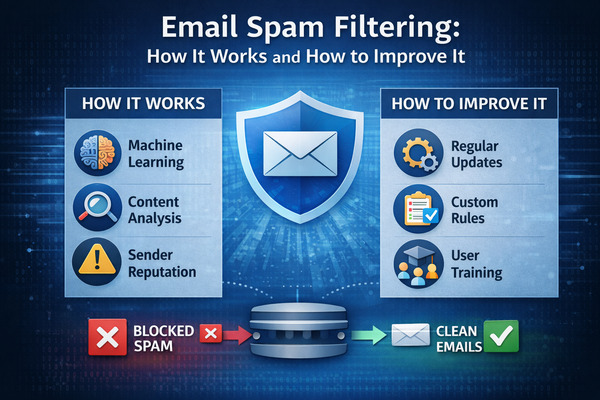
Email spam filtering is a critical cybersecurity process that automatically detects and blocks unwanted, malicious, or unsolicited emails before they reach your inbox. As email remains a primary communication channel for both businesses and individuals, effective spam filtering is essential for maintaining security, privacy, and productivity.
Modern spam filters go far beyond basic junk mail detection. They protect against sophisticated threats such as phishing attacks, malware, and business email compromise (BEC). Using advanced technologies like machine learning, sender authentication protocols, and behavioral analysis, email filtering systems evaluate incoming messages in real time to ensure accurate spam detection while minimizing false positives.
If you want to clean your inbox and reduce spam for free, download our Cleanfox platform today.
Understanding How Email Spam Filters Work

Say goodbye to spam, clutter, and chaos.
Our smart email cleaner filters out junk, organizes your inbox, and helps you focus on what really matters.
✅ Block spam automatically
✅ Organize emails by priority
✅ Keep your inbox clean
✅ Clean old emails you don’t read
📱 Available on the App Store and Google Play.


The Role of Machine Learning and AI
Imagine your spam filter as a smart guard dog that learns from every encounter. This is where machine learning and AI excel in modern email filtering. These advanced technologies analyze vast amounts of email data, identifying patterns in content, sender behavior, and metadata to classify messages. They go far beyond simple keyword matching, achieving high accuracy through models like decision trees, support vector machines, and neural networks.
By examining features such as subject lines, email body content, and anomalies in traffic patterns, AI-driven filters continuously improve. They learn from user feedback to reduce false positives and adapt to evolving spam tactics, ensuring stronger protection over time.
Common Techniques Used in Spam Filtering
At the core of these systems are techniques like natural language processing (NLP), which analyzes an email’s context, tone, and semantics. Deep learning models uncover complex patterns in text and headers, further enhancing detection capabilities.
Other key methods include anomaly detection for unusual emails, traffic analysis for identifying mass spam campaigns, and authentication protocols such as SPF, DKIM, and DMARC. These protocols verify legitimate senders and work together within cloud-based spam filters to provide a robust defense against unwanted emails.
Dynamic Adaptation to New Threats
One of the most important strengths of modern spam filters is their ability to evolve dynamically. They leverage real-time threat intelligence and user interactions to counter emerging risks, including AI-generated phishing attacks.
Through continuous model training and optimization, including hyperparameter tuning and cross-validation, these systems adapt to new and previously unseen email threats. This ensures your secure email gateway blocks the latest malicious messages without requiring constant manual intervention.
Types of Email Spam Filters and Their Effectiveness
Content-Based Filters
Filters are often the first layer of email security. These filters scan the body and subject line of an email, searching for specific keywords and phrases that typically signal spam. They also evaluate metadata alongside the email content itself to identify suspicious patterns.
The strength of content-based filtering lies in its straightforward approach: if an email contains red-flag words or formatting characteristics commonly associated with spam, the filter flags it for review or blocks it entirely. However, their effectiveness has limitations, especially against sophisticated phishing attempts that use legitimate-sounding language to evade detection.
Sender Reputation Filters
Sender reputation filters take a more contextual approach by examining the history and credibility of the sender. These systems cross-reference email addresses and domains against blacklist databases of known spam sources, while also checking whitelist filters that allow trusted senders to pass through.
Technologies such as real-time blackhole lists (RBL) verify whether an email originates from known spam IP addresses, adding a powerful layer of protection. While highly effective against bulk spam campaigns, determined threat actors may attempt to spoof sender addresses to bypass these defenses.
Behavioral and Heuristic Filters
Heuristic filters use advanced algorithms to evaluate multiple factors, including sender patterns, timing, recipient behavior, and anomalies in message structure, to estimate the likelihood that an email is spam. Instead of relying solely on known bad patterns, they detect suspicious deviations from normal email behavior.
Bayesian filters represent one of the most adaptive approaches in this category. They continuously learn from user actions—such as marking emails as spam—and gradually improve their accuracy over time. These filters are particularly effective at blocking messages designed to bypass other defenses by altering content while retaining similar structural characteristics. Their adaptive nature makes them highly effective at detecting emerging email threats before they reach the inbox.
Improving the Effectiveness of Spam Filtering
Regular Updates and Patching
Spam filters are only as effective as their most recent updates. Regular updates and patching ensure email security systems remain resilient against evolving threats, as attackers continuously develop new tactics to bypass existing defenses.
Cloud-based filtering systems typically receive automatic updates. However, organizations managing on-premise solutions must implement a disciplined schedule for applying security patches and updating filtering algorithms. Machine learning models also require continuous retraining with new spam datasets to maintain their effectiveness against emerging threats.
Customizing Filters to Fit Specific Needs
A one-size-fits-all approach rarely provides optimal protection. Rule-based filters allow organizations to define specific criteria tailored to their unique needs, including custom handling of keywords, sender addresses, domains, or phrases within the email body.
Administrators can establish global security policies across users, such as blocking certain attachment types or flagging emails containing sensitive terminology. These measures help ensure compliance while minimizing false positives that could block legitimate communication.
Trusted sender lists can also be configured by whitelisting approved email addresses and domains, providing granular control over inbox traffic. End users should understand how to approve or deny senders individually, allowing personalization without compromising overall security policies.
Integrating Multiple Layers of Defense
The most effective spam filtering strategy combines multiple complementary techniques rather than relying on a single method. A layered defense model integrates content analysis, sender reputation evaluation, and behavioral detection within a unified secure email gateway.
Anti-spam and anti-virus software should serve as the foundational layer, ideally with a third-party filtering solution operating alongside a cloud-based email provider. Domain authentication through SPF, DKIM, and DMARC records further verifies legitimate senders and protects organizational reputation.
Filtering systems should scan both inbound and outbound emails to detect compromised accounts that may attempt to distribute malicious content. In addition, employee awareness training remains essential, as user reports of suspicious messages help refine filtering algorithms and strengthen protection over time.
Conclusion
Effective email spam filtering requires a multi-layered approach that combines content analysis, sender reputation checks, and behavioral detection powered by machine learning. The strongest defenses integrate SPF, DKIM, and DMARC authentication protocols with anti-spam and anti-virus software to protect against both inbound and outbound threats.
To remain resilient against evolving email risks, ensure filtering systems receive regular updates and continuous model training. Customizing rules to align with organizational requirements helps minimize false positives while maintaining strong security standards. User education also plays a critical role, reinforcing human oversight as an additional layer of defense.
Implementing these strategies establishes a comprehensive shield against spam, phishing attempts, and malicious content that could compromise inbox security.
FAQ
What are the main mechanisms used in email spam filtering?
Email spam filtering relies on several core mechanisms to detect and block unwanted messages:
- Rule-based filters that analyze keywords and predefined conditions
- Content analysis techniques such as Bayesian filtering and heuristic evaluation
- Machine learning models that adapt to evolving spam patterns
- Sender reputation systems that evaluate IP addresses and blacklist databases
- Header validation using authentication protocols like SPF, DKIM, and DMARC
- Greylisting, which temporarily rejects emails to confirm sender legitimacy
Why do legitimate emails sometimes end up in spam folders?
Legitimate emails may be mistakenly flagged as spam due to:
- Poor sender reputation
- Spam-like content, including excessive capitalization or too many links
- Missing or misconfigured authentication records (SPF, DKIM, or DMARC)
- Suspicious attachments or formatting
- High bounce rates or repeated spam complaints
- Recipient-specific filtering rules that block certain senders or content
What common triggers cause emails to be flagged by spam filters?
Spam filters are commonly triggered by:
- The use of spam-related words such as “free” or “urgent”
- Weak sender authentication or a damaged domain reputation
- Misleading or clickbait-style subject lines
- Excessive use of images or embedded links
- Sending emails to outdated or low-quality contact lists
- Low engagement rates, such as consistently unopened emails
- Absence of a clear and accessible unsubscribe option
- Frequent user complaints
How can I improve email deliverability to avoid spam filters?
To improve email deliverability and reduce the likelihood of being flagged as spam:
- Ensure full authentication with SPF, DKIM, and DMARC
- Regularly clean email lists by removing inactive subscribers
- Maintain a consistent sending schedule to build domain trust
- Personalize email content to increase engagement
- Monitor open rates, click-through rates, and complaint metrics
- Gradually warm up new domains to establish a positive reputation
- Avoid purchasing email lists or sending messages without explicit permission
